
We Keep Us Safe
Why demand an agency shop?
In January 2025, Caltech Graduate Student Workers and Postdocs ratified an industry-setting first contract which includes a strong agency shop to enforce the contract we collectively fought for.
Power comes from organized people and organized money. Our union is the only legal means we have to challenge the imbalance of power between GSWs and Postdocs and the Caltech administration. We know that Caltech is well-resourced, and in turn, we must have the resources to level the playing field.
Agency shops are unionized workplaces where workers have a choice in whether or not they become union members. With an agency shop all workers who are covered by a union contract pay a small portion of their paycheck to contribute financially to their union in the form of union dues (or fees, for non-members). Workers have a real say in our working conditions, and union security rights provide GSWs and Postdocs the power to enforce our new contract collectively.
A worse alternative would be an open shop: all GSWs and Postdocs benefit from our new contract, but no one has to chip in for the costs of representation. This would weaken our power by denying us the resources to address violations of our contract and build a strong union for the next set of contract negotiations. Without an agency shop, our industry-leading wins like the guaranteed timeline of 90-days to mediate bullying, harassment, and discrimination cases will mean less. Our union is strengthened by an agency shop—especially under the Trump administration.
“Bargaining for Stronger Protections for International Scholars at Caltech”: Read the op-ed.
By having strong contract enforcement mechanisms, UAW members at other universities have successfully kept each other safe:
-
- UC San Diego: An international postdoc who was seven months pregnant was fired by her PI after raising concerns about data falsification. Her coworkers rapidly organized and were able to prevent her deportation to China. She was reinstated to a new position with full restoration of healthcare benefits.
- UCLA: A pregnant postdoc was bullied by her PI to such a degree that it was affecting the health of her unborn child. Through the grievance process, interim safety measures were imposed that required the PI to alter his schedule to avoid crossing paths with the postdoc.
- UC Berkeley: An international postdoc’s PI attempted to fire them for no justifiable reason on Christmas Eve. Because of the grievance procedure outlined in the union contract and an organized Chemistry Department that was ready to protest on behalf of the postdoc, the PI had to rescind the notice and sign a no-contact order and non-disparagement agreement. The postdoc was able to move to a different lab and finish their work at Berkeley.
- UC Riverside: Two postdocs who were being harassed for not publishing fast enough were given new appointments with department funding after the successful implementation of the grievance process and a march to the department chair’s office led by dozens of their coworkers.
UAW academic workers have also worked together to:
- Stop the “fixed duration of status” rule from going into effect
- Expand and extend Optional Practical Training (OPT)
- Oppose the 1-year period of validity for Chinese entry visas
- Organize information sessions in response to changing immigration policy under Trump
- Extend the initial postdoc employment contract to a 2-year period to reduce visa costs and provide immigration stability for scholars and their dependents
- Fought pandemic-era ICE-deportations of academic workers
- Joined lawsuits to protest the Muslim ban
- Joined lawsuits against Betsy Devos’s Title IX changes
Frequently Asked Questions
What does it mean to be a member of my union?
Signing up to be a dues-paying member of your union once we ratify our first contract means choosing to join a majority of your coworkers in signing up for membership. Strong membership is essential to building a strong union; high membership demonstrates to the Caltech administration that Graduate Student Workers and Postdocs are united and ready to exercise our rights, and it ensures that GSWs and Postdocs, through our union, can effectively pool our resources together and improve our working conditions.
Members, and only members, have a voice in shaping the union’s priorities, electing and running for union leadership, and participating in union committees. Membership sign ups will begin soon as our contract is set up to be enforced.
What are dues? Why are dues important?
Dues are union members’ financial contribution to the operation of the union and to the union’s capacity to advocate for change. Membership dues are important because they provide the resources necessary for our union to be effective.
Dues are critical for providing our union with independent resources that are not controlled by the Institute. GSWs and Postdocs will use them to ensure we have appropriate legal, bargaining, community and staff support to support all GSWs and Postdocs. Dues are also important in that they allow GSWs and Postdocs to pool our resources and level the playing field with Caltech, which is an extremely wealthy institution.
Members, and only members, have a voice in shaping the union’s priorities, electing and running for union leadership, and participating in union committees.
Membership dues also help our broader union organize together to counter Trump-era reforms, which so far has already proved to have negative impacts to researchers everywhere, including at Caltech.
What are agency fees? How are they different than dues?
The contract and its enforcement applies to all Postdocs and GSWs in the bargaining unit regardless of union membership. Since GSWs and Postdocs won an agency shop in the Union Security article, all bargaining unit members are required to pay agency fees or membership dues should they choose to be a member. Agency fees are a subset of dues that covers the cost of representational fees of our union.
Union members elect to pay union dues (1.44% of gross pay) in order to have a strong say in their workplace through organized money and organized people. Some opt out of membership and elect to instead pay an agency fee (1.17% of gross pay). Postdocs and GSWs would pay either dues or agency fees, not both.
How do dues and agency fees work?
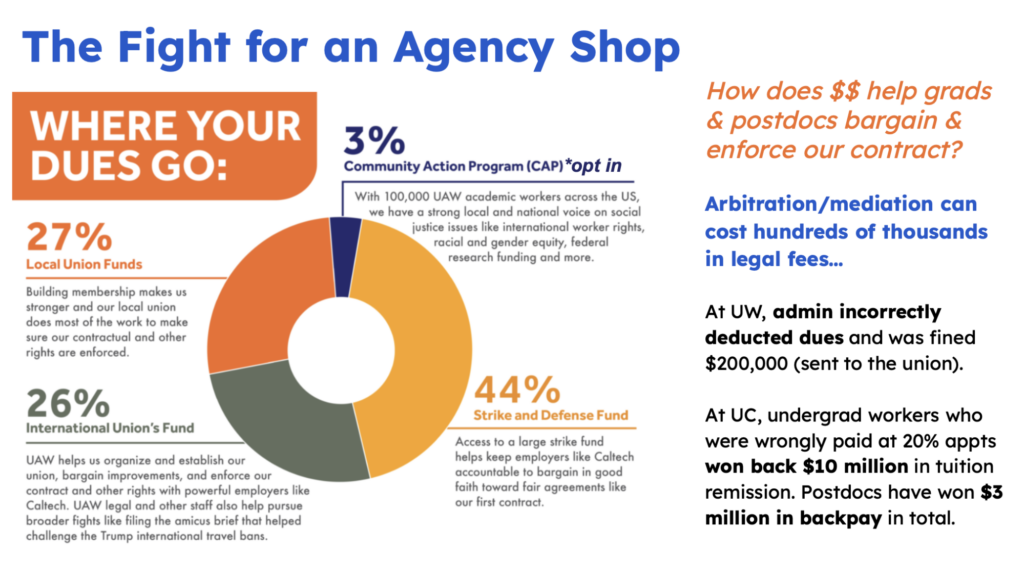
Dues are important because they provide the resources to effectively organize, negotiate with Caltech, and ensure our rights are protected. This includes legal support, educating new Grads/PDs about their rights, advising Grads/PDs through difficult situations, future contract negotiations, and continued advocacy. Union members democratically decide how dues are spent.
Nobody will pay dues until after Grads/PDs negotiate and then vote to ratify a first contract. Dues in UAW are 1.44% of gross income. There is also a one-time union initiation fee, which in other UAW academic unions is $10.
Once our union is established, local union expenses will be approved by an elected executive board of grads and postdocs. Local unions also draft and approve a budget at the start of each year. Trustees elected by grads/PDs will also audit the union’s income and expenditures twice annually.
Most of the day-to-day work of enforcing a union contract and representing members is supported by local union dues. In other unions, this includes:
- Educating new employees about their rights and their union
- Contract negotiations
- Advising grads/PDs in difficult situations and supporting them through the grievance process
- Events, including seminars on topics like visa and immigration rights, filing taxes, and healthcare
- Advocacy for public policy that supports higher education and research
The Local Union may also receive an additional “rebate” if the Strike and Defense fund is over $500M.
26% of Dues go to the International Union’s general fund, which provides technical support for contract negotiations, support for contract enforcement, and helps other groups of workers successfully form unions (like CGPU-UAW). Some ways international union dues will support CGPU-UAW include:
- Providing experienced negotiators, researchers, and legal help to aid grads/PDs in achieving their goals at the bargaining table.
- Legal advice and advocacy to impact policy makers, especially those in Washington, DC. For example, UAW is part of ongoing advocacy to improve visa and immigration policy for international researchers.
- Support for grievances and arbitration. For example, at UC Berkeley UAW International helped teaching assistants win millions in unpaid tuition remission.
- Working to expand the rights of grads and postdoc. For example, winning the landmark NLRB decision that enables Graduate Employees at private institutions to collectively bargain.
- Helping to win political support for our priorities as grads and postdocs. See, for example, this letter to UC from Katie Porter and 29 other members of the California Congressional Delegation calling on UC to recognize the newly formed UC Student Researcher union.
44% of dues money goes to the strike and defense fund. This fund supports workers with pay should they choose to go on strike (see also “Will we have to go on strike?” in this FAQ). When the strike fund is over $500 million, a portion of dues normally allocated to the strike and defense fund may be returned to the local union.
A portion of dues money (3%) goes to support political action, including legislative and other policy advocacy on issues that matter to UAW members. For example, UAW advocates strongly for fair, comprehensive immigration reform, which would include more visa access and an improved green card process, and expanded federal support for research funding, among other topics. [NOTE: dues money cannot be used for federal campaign contributions, such as the presidential race—that money comes from voluntary contributions through a program called VCAP (Voluntary Community Action Program)].
When would union dues and agency fees go into effect?
Under the contract, union dues / agency fees would not go into effect immediately. Dues will take effect at least 60 days after ratification and after the agreement is in full effect and it’s ratification bonus is distributed.
What if I do not want to contribute to strengthen resources for contract enforcement?
Article 37 of our contract requires all covered GSWs and PDS to join the Union and pay monthly dues, or if not joining the Union, to pay a monthly agency fee. Dues are 1.44% of gross monthly income, and agency fees are currently 1.17% of gross monthly income. Dues and agency fees may be paid by authorizing Caltech to deduct them directly from your pay each month, or by paying them directly to our Union each month. Membership sign ups will begin soon as our contract is set up to be enforced.
This FAQ contains information about your rights under the Supreme Court ruling Beck v. CWA, which is also available at https://uaw.org/union-security-agreements/. If you have a sincerely held religious belief that you believe conflicts with the payment of union dues or agency fees, please write to the Secretary Treasurer of the International Union, UAW at 8000 East Jefferson Avenue, Detroit, MI 48214.
GSWs and Postdocs are speaking up
Below are just a few experiences and stories from different labs that colleagues shared to show administration that our campus needs real change.
“My previous PI would harshly yell at me when ordering directives for my research, and said that if I tried to move to another group at Caltech, they would try to sabotage me. This PI would also abuse others in our group, regularly calling one ‘stupid’ and discriminating against another on the basis of their visa.”
“I endured frequent mistreatment which included my advisor aggressively emailing and shouting about research and results. We would have scientific disagreements about methodology which would end in threats towards my visa: ‘If you don’t agree, go ahead and leave.’ Right now, my advisor is withholding my waiver for an H1B and it is known in the academic community that my advisor has done this before to other Postdocs on J1 visas. Guaranteeing access to H1B applications for Postdocs would give me hope.”
“I was sexually harassed by a GSW during orientation week about my sexual orientation and gender identity. This GSW had also sexually harassed several other GSW, many of whom (including myself) anonymously reported to Title IX. Not only did Title IX require I have a video call with the staff (despite the request for anonymity), I sat for 90 minutes during my appointment and no one showed up. I followed up with an email and I was told there was a scheduling error but no other appointment was made and my report fizzled out to nothing.”
“There is a PI in my wider research group who is well known for bullying postdocs, GSWs, undergrads, and even SURF students. This includes shouting at them in meetings, intimidation, and unreasonable pressure to work very long hours. This behavior goes unchecked, especially by the other PIs…despite everyone knowing that it happens often. A proper grievance process would allow us to finally address this issue.”
“My advisor bullied me and told me that I was not cut out for a PhD at Caltech. Even after being awarded a prestigious grant, my advisor consistently questioned my competence and commitment to my graduate studies. My mental health severely deteriorated in this working environment.
After meeting with Dean Chan about my working environment, he was concerned about my experiences, but claimed nothing could be done because ‘bullying is hard to pin down.’”